
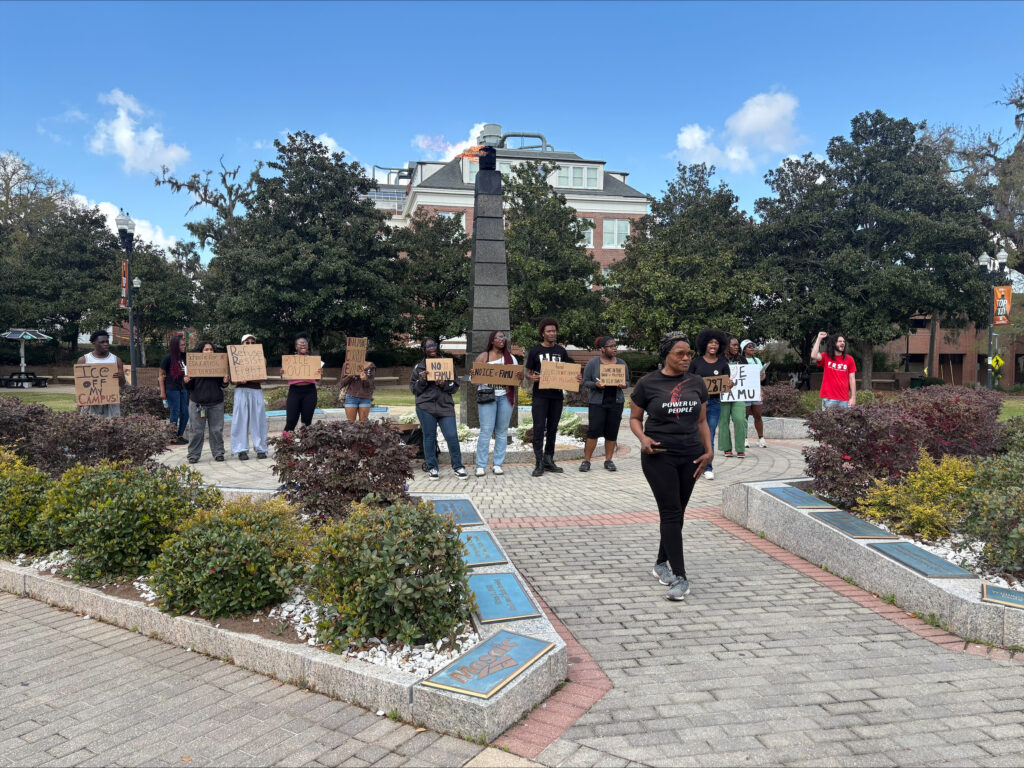
A protest led by Students for a Democratic Society (SDS) at Florida A&M University, organized last month, has continued to raise awareness of the university’s participation in the 287(g) agreement, a federal program that pairs local law enforcement with U.S. Immigration and Customs Enforcement (ICE).
Concerns over the policy’s possible effects on immigrant communities and the campus environment arose at the March 6 protest, which brought together FAMU students, student organizations, community advocacy groups, and college students.
According to SDS members, the demonstration focused not only on the agreement but also on ensuring students feel safe on campus.
“We don’t want ICE on our campus,” said Jayla Jones, vice president of SDS. “We want to be able to get our education peacefully, whether you’re an immigrant student or not.”
Under the 287(g) program, trained local police can work with ICE to perform certain immigration enforcement tasks. Advocates argue that the approach may weaken community trust in law enforcement and increase the risk of racial profiling.
The problem is personal for some students.
“I’m the child of two immigrants, so this is very personal for me,” said Zoe Bantin, a member of SDS and other advocacy organizations. “Racial profiling doesn’t just affect immigrants; it can affect anyone.”
Bantin stated that SDS used informative videos and posts on social media to raise awareness of the agreement to a larger audience.
“We focused on making information accessible so students could understand what’s happening,” she said.
Planning for the demonstration began about two weeks in advance, according to student SDS members; it came together quickly. Participants from across campus and the surrounding Tallahassee community were invited out via flyers, social media outreach, and word of mouth.
Alongside students, community members expressed solidarity by emphasizing concerns about the agreement’s impact beyond the campus.
“It doesn’t make sense to have a 287(g) agreement on an HBCU campus when it goes against the values of fighting oppression and protecting our community,” said Trish Brown, a representative of the organization Power Up People.
Brown emphasized the importance of unity, noting that collaboration between students and the broader community is needed for lasting change.
“We can’t do this alone,” Brown said. “It takes students, organizations, and the community coming together to make change.”
Protesters call on the university’s leadership to be more transparent and reconsider its involvement in the agreement.
“Universities are under no legal obligation to be in the 287(g) agreement,” Bantin said. “We want FAMU, the Board of Trustees, and FAMU PD to end this agreement and take a stand, because this affects every student on this campus.”
Brown, meanwhile, said she expects continued organizing beyond the protest as students and community members push for sustained engagement on the issue.
“We need folks to stay involved and keep building power together,” she said.
SDS members said that they hope the protest sets a trend of continuous advocacy and discourse
.
“If we allow one community to be targeted, then all of us are at risk,” Bantin said. “We have to protect each other.”
FAMU has not issued an official public statement addressing the issues raised during the March 6 protest. To keep students informed and proactive, SDS members said they want to continue arranging and seeking contact with administrators, including through forums and educational events.
Brown said that moving forward, it is important for student and community organizations to continue organizing and working together.
“We can’t just rally and protest; we have to strategize on how we continue to protect people in our communities,” Brown said. “We need folks to come together in solidarity, stay engaged, and keep pushing forward to create systems that actually support students and communities.”